Categories &
Functions List
Function Reference: geom.largestrect
drafting: R = geom.largestrect (P)
drafting: R = geom.largestrect (P, MARGINS)
drafting: [R, B] = geom.largestrect (…)
Largest axis-aligned rectangle inscribed in a rectilinear polygon.
R = geom.largestrect (P) returns the largest
axis-aligned rectangle that fits inside the polygon P, as a 4-by-2
matrix of vertices wound counter-clockwise starting from the lower-left
corner.
R = geom.largestrect (P, MARGINS) additionally
keeps the rectangle clear of every wall of P by the given
margins, the face of a notch included and not merely the bounding box.
MARGINS is a scalar applied to all four sides, or the 1-by-4 vector
[left, bottom, right, top] naming them
individually, in the units of P. All values must be non-negative and
it defaults to zero.
Clearance is measured per axis, so the right margin is held against whichever wall bounds the rectangle on its right — the outline’s own right-hand side, or the inner face of a notch, whichever it meets first.
This is the operation that fits a usable rectangle inside an irregular outline: the per-side margins are the clearance budget — whatever has to be kept free along each side — and the result is the largest rectangle that budget leaves room for.
[R, B] = geom.largestrect (…) also returns the
rectangle in the compact form
[xmin, ymin, xmax, ymax] used by
geom.bbox.
Rectilinear input only. P must satisfy
geom.isrectilinear. The search considers only rectangles whose edges
lie on lines through vertices of P, which is exactly where an optimal
rectangle must lie when the outline is rectilinear; on a sloped edge that
reasoning fails and the answer would be wrong rather than merely
conservative, so such input is rejected instead.
Where several rectangles tie for the largest area, the first encountered is returned, scanning x bounds before y bounds and each in ascending order. The result is therefore deterministic.
See also: geom.bbox, geom.offset, geom.isrectilinear
Source Code: geom.largestrect
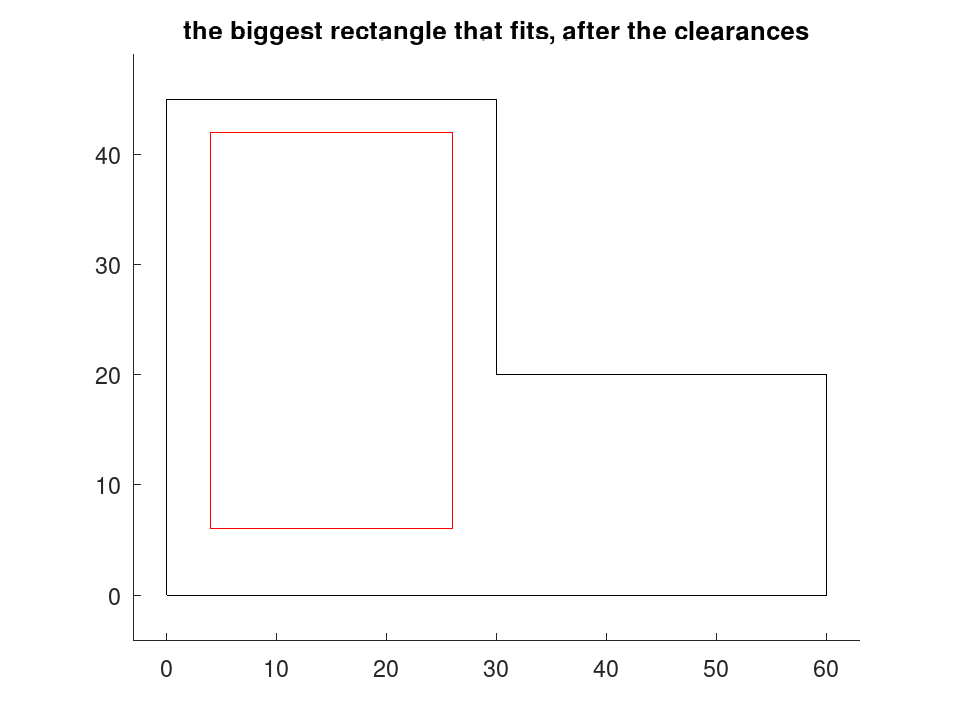
The largest axis-aligned rectangle that fits inside an outline, with a per-side clearance kept free. The margins are the budget; the rectangle is what that budget leaves room for.
 P = [0, 0; 60, 0; 60, 20; 30, 20; 30, 45; 0, 45];
 [R, B] = geom.largestrect (P, [4, 6, 4, 3])
R =

    4    6
   26    6
   26   42
    4   42

B =

    4    6   26   42
 D = draw.Drawing ().polyline (geom.Polyline (P, 'Closed', true));
 D.Colour = 'red';
 D = D.polyline (geom.Polyline (R, 'Closed', true));
 plot (D);
 title ('the biggest rectangle that fits, after the clearances');